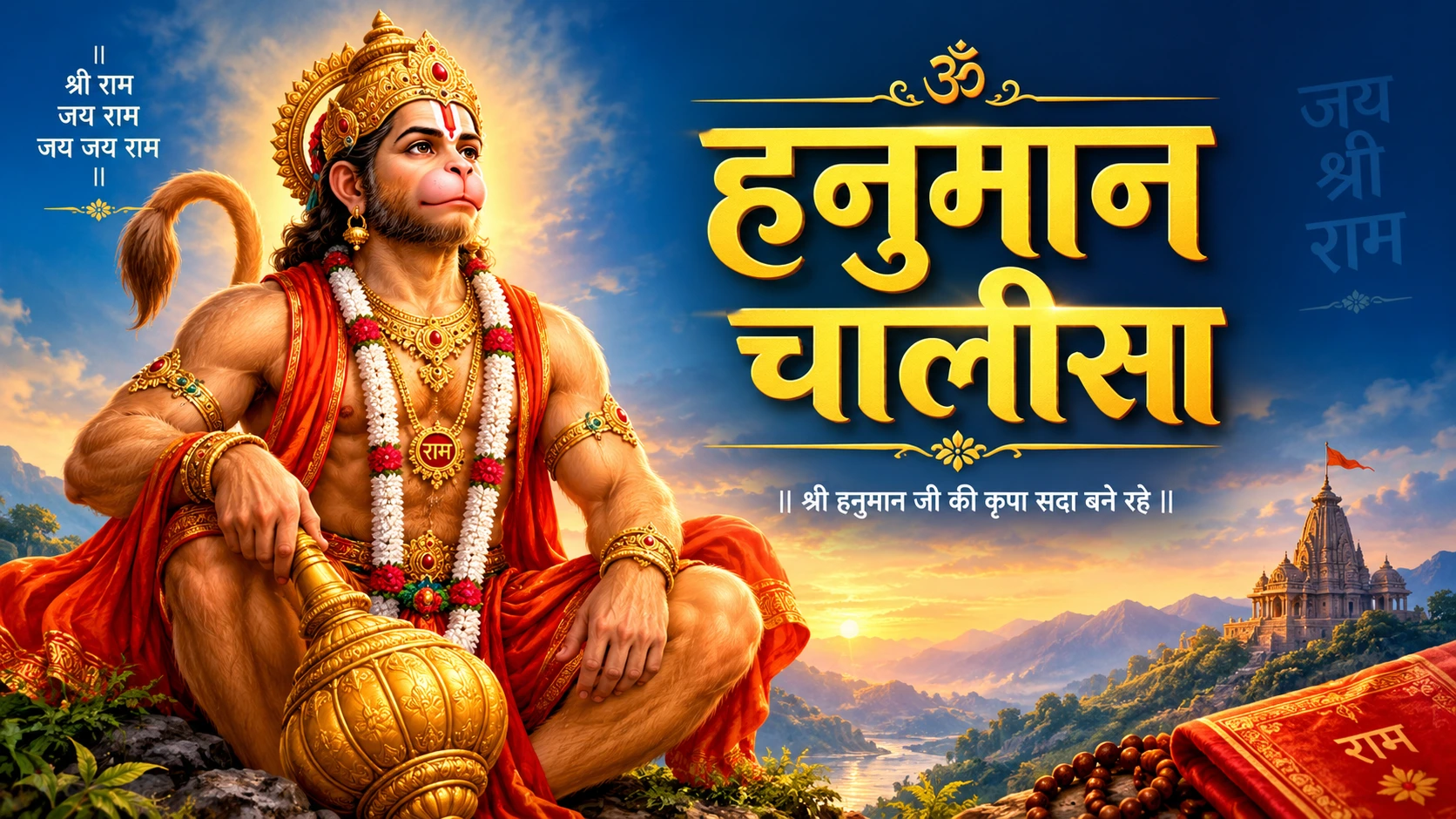
hanuman chalisa
Hanuman Chalisa: Devotion That's Over Four Hundred Years Old, and Still Just as Alive
Let me ask you something. During a crisis, when your mind feels tangled, or on a night when sleep just won't come — have you ever listened to the Hanuman Chalisa? In most Nepali and Indian households, it's the kind of thing you've heard at some point or another — from a parent's voice, from the radio, or drifting out of a temple's loudspeaker. But the story behind it, its structure, and why it touches so many people so deeply — few actually know that part.
So today, let's talk about exactly that.
Who wrote it, and when?
The Hanuman Chalisa was written by Goswami Tulsidas. This sixteenth-century saint-poet also composed the epic Ramcharitmanas, but the Hanuman Chalisa is different — small in size, simple in language, yet remarkably deep in feeling. Nobody knows the exact date it was written, but most scholars guess it was composed toward the end of the 16th century.
Here's something interesting: it's written in Awadhi, not Sanskrit. And maybe that's exactly why it settled so easily into so many mouths. When language becomes simple, devotion becomes simple too, doesn't it?
So what does "Chalisa" actually mean?
The word "Chalisa" comes from "chalis," meaning forty. The text contains forty couplets and quatrains — add the two opening and two closing dohas, and you get forty-three verses in total. The structure is so tightly organized that you can tell right away this wasn't written in a rush. Every word feels chosen on purpose.
The opening doha is Tulsidas paying tribute to his guru. From there, the verses move into praising Hanuman's wisdom, strength, and devotion, gradually weaving in episodes from the Ramayana — the search for Sita, the burning of Lanka, the fetching of the Sanjeevani herb — all packed into short, memorable lines.
Why did it become so popular?
I think the biggest secret behind its popularity is simplicity, plain and simple. Unlike the dense, complicated verses of Sanskrit scripture, the language and rhythm of the Hanuman Chalisa are such that an uneducated grandmother in a village can memorize it just as easily as a university professor in Kathmandu can read it and grasp its deeper meaning.
And there's another thing — Hanuman himself is an "easy" god, in a way. He's powerful, but never arrogant. He's wise, but never proud. And the biggest thing of all: his devotion to Ram is complete and utterly selfless. That's exactly what people look for in their own lives — someone to believe in, someone who won't abandon them.
What do people say about it?
Ask many devotees about their experience, and they'll tell you the same thing — when fear creeps in, when the mind grows restless, or when some major obstacle shows up, reciting the Hanuman Chalisa brings a certain kind of steadiness to the mind. In scientific terms, you could even call it a form of meditation — the rhythmic recitation calms the brain, regulates the breathing pattern.
But I think there's more to it than just science. There's a kind of collective memory tied up in it too. You are not alone when you say it. Centuries of millions and millions of people have been saying these words. That connection, that shared experience, is a power unto itself.
In the end
The Hanuman Chalisa isn't just a religious text. It's a piece of cultural heritage that has connected generation after generation for four hundred years. Fathers teach it to their sons, grandmothers recite it to their grandchildren, and this is exactly how the tradition of words stays alive.
If you've never recited the whole thing yourself, give it a try sometime. Don't rush through it — read it with understanding. You might just discover why this small piece of verse has been winning people's hearts for so long.


प्रतिक्रियाहरू (0)